Elixir for Founders: Four Reasons to Start With It or Move to It
Your stack is a money decision
I run an Elixir agency, so yes, I'm biased. Keep that in mind and check every number below. The links are there for that.
Before the agency I spent more than ten years building products on other stacks, from MVPs with impossible deadlines to systems with millions of users. The pattern I kept seeing: the stack gets picked in one afternoon, usually because it's what the first developer already knew, and then the company pays for that afternoon for years. In salaries, in cloud bills, and one day in a rewrite.
Short version: Elixir lets a small team do the work of a big one on a couple of servers, and you don't have to rebuild it when you grow. Below are four reasons. They work if you start from zero, and they work if you already have a product that gets slower and more expensive to change.
1. One engineer ships the whole feature
On a typical stack one feature needs a backend developer, a frontend developer, an API between them and somebody who understands the job queue. That's two codebases and a meeting about JSON.
With Phoenix (the Elixir web framework) the interactive UI is rendered from the server. There's no separate frontend app and no API in between. Background jobs, caching and live updates sit in the same codebase and the same language, so one person can take a feature from the database to the screen.
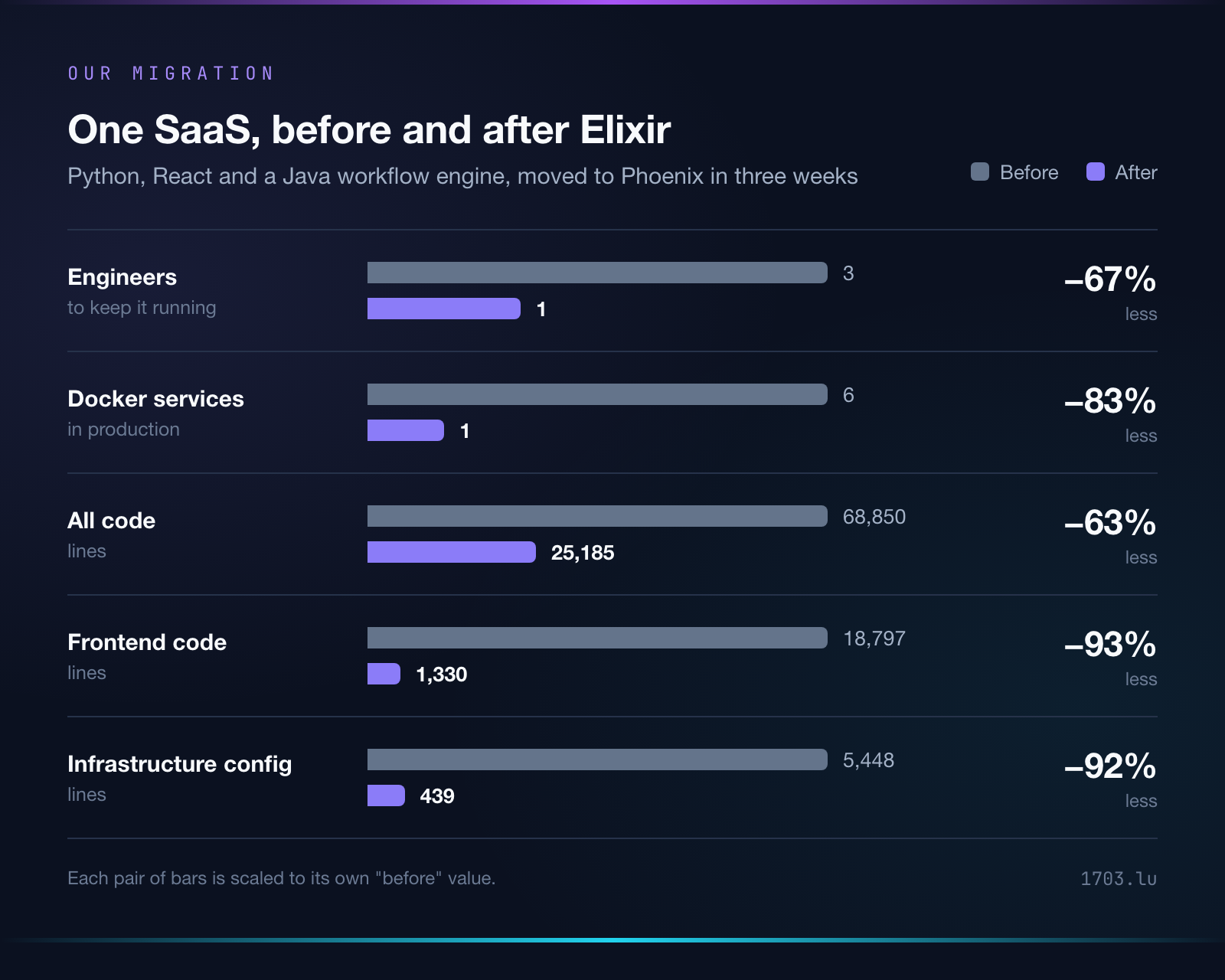
We saw it on our own project. We took over a B2B SaaS that needed three engineers just to stay alive. After a three week migration it needs one. 68,850 lines of code became 25,185, and the frontend went from 18,797 lines to 1,330.
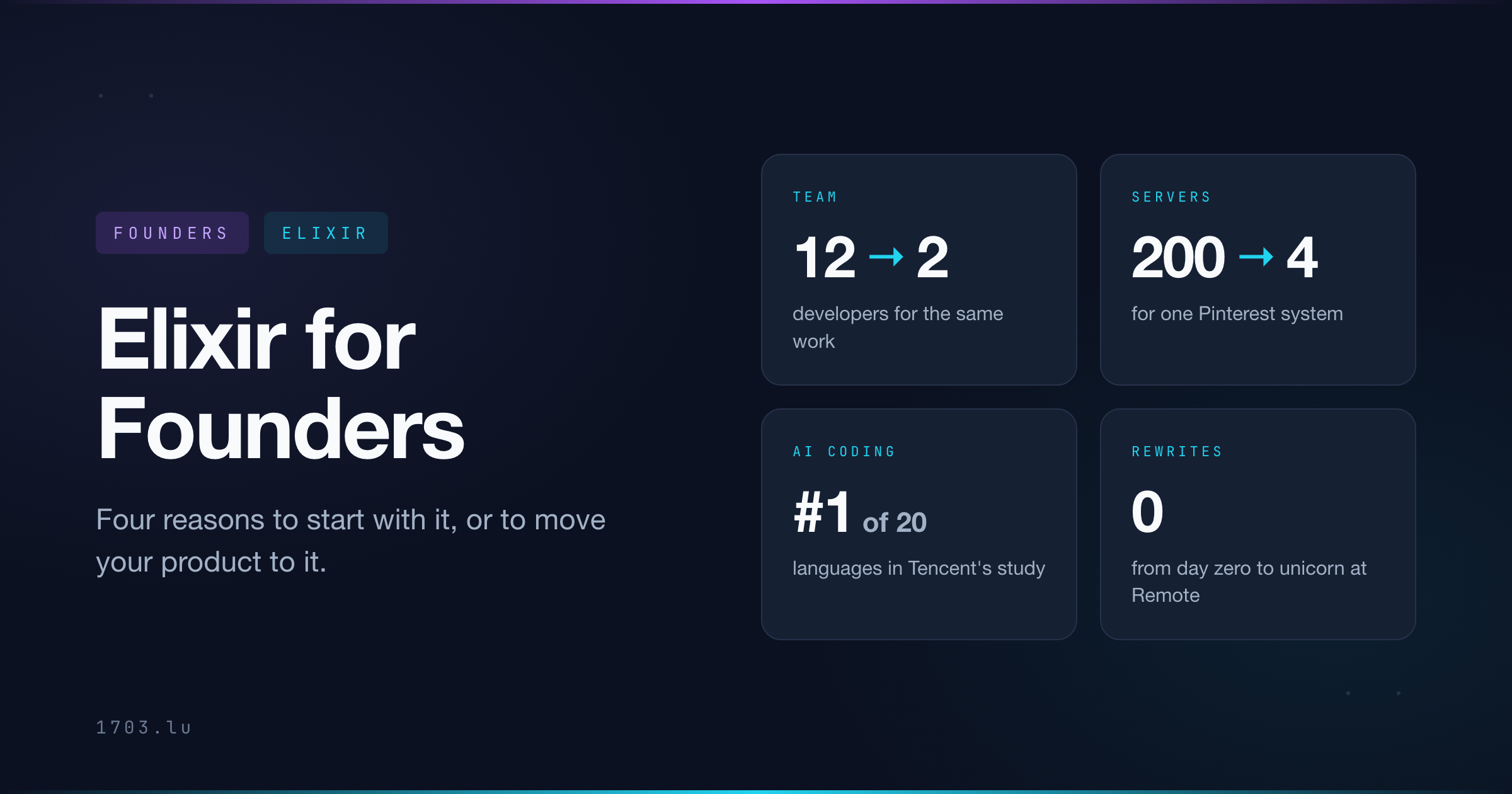
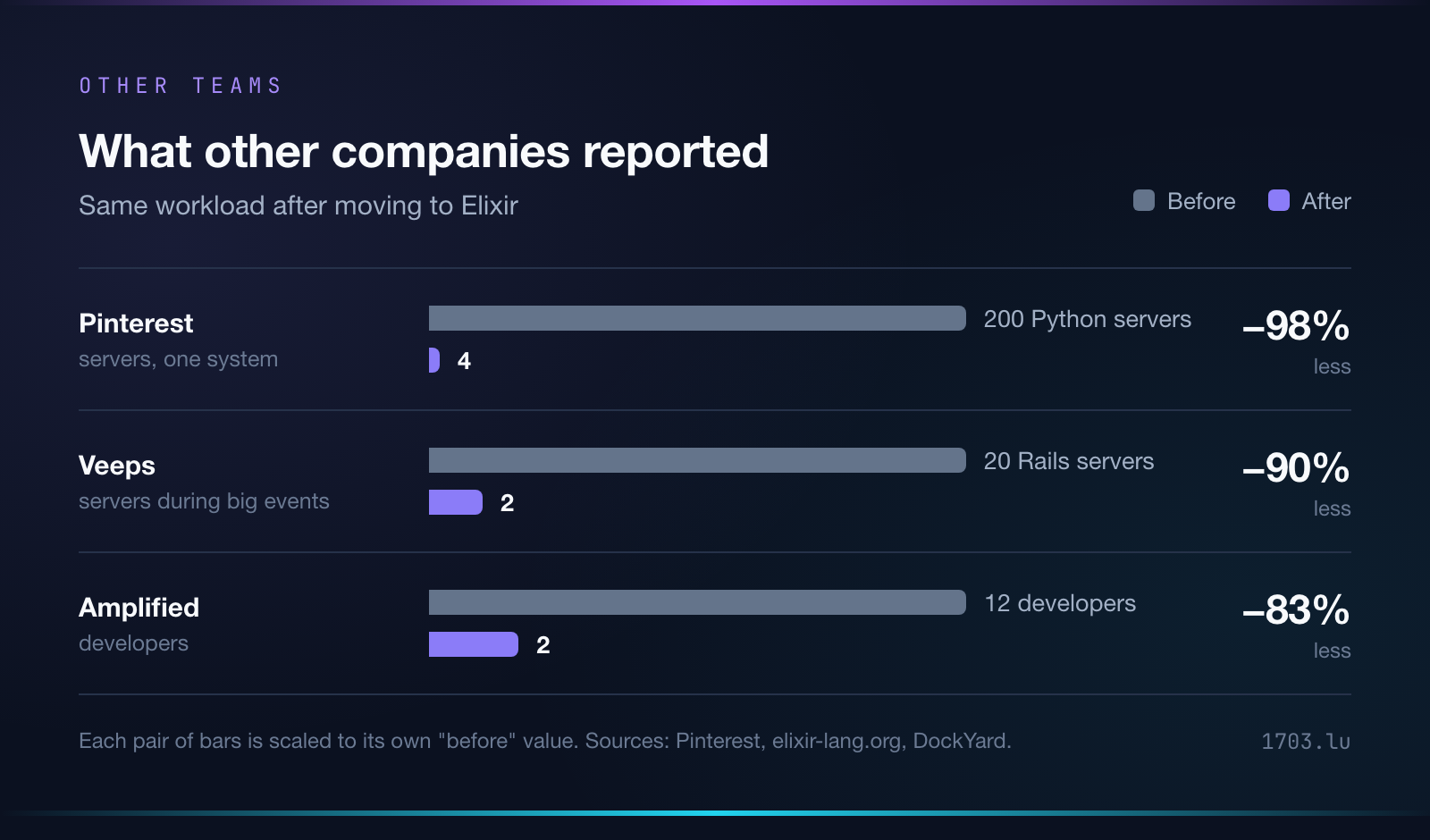
Amplified, an AI patent search startup, tells the same story. They moved from React and Python to Elixir, and now two developers do the work that used to need twelve. Their AWS bill halved on the way. (The write-up comes from DockYard, who sell Elixir consulting like we do, but the quotes are from Amplified's CTO.)
Salaries are the biggest cost you have. I don't know a cheaper way to get runway than not needing the hire in the first place.
2. Six services become one
Products collect infrastructure as they grow. Redis for caching, a queue for background work, a separate server for anything real time, maybe a workflow engine. Every one of them is a bill and one more thing that breaks at 3am.
Elixir runs on a VM called the BEAM, and the BEAM already does caching, background jobs, messaging and live connections. So production can stay what it was on day one: an app and a database.
Pinterest said Elixir saves them over $2 million a year in servers. One of their systems went from 200 Python servers to 4.
Veeps (concert streaming, owned by Live Nation) rewrote their Rails backend in Elixir in eight months. A service that needed 20 Rails servers during big events now runs on 2, and the platform takes 83 times more concurrent viewers. Their backend team is two people.
In our migration six Docker services became one and four programming languages became one. 5,448 lines of infrastructure config went down to 439. We didn't tune Redis or Elasticsearch, we deleted them.
The cloud bill is the part you see. What I like more is everything around it: less to monitor, less to secure, a shorter due diligence call, and nobody whose full time job is plumbing.
3. AI writes better Elixir than anything else
Most code is written with an AI assistant now. So I'd ask a different question than "which language do my developers like". Which language does the machine get right?
Tencent tested it. Their AutoCodeBench study ran 3,920 problems in 20 programming languages on more than 30 models, and Elixir had the highest completion rate of all 20.
It sounds backwards, because Elixir is small next to Python or JavaScript and the models have seen much less of it. José Valim, who created the language, explains why it works. My short version: data in Elixir doesn't change behind your back, so what the model reads is what actually runs. There's usually one obvious way to do a thing. And the whole product is one codebase, so the assistant sees the full feature and doesn't have to guess across three repos.
To be honest, a benchmark is a set of small closed problems and a product is not. But it matches what we see on client work every day. The assistant is right on the first pass more often, and one engineer covers ground that used to need a team.
So reason 1 means fewer engineers, and reason 3 makes each of them faster.
4. You never pay for the rewrite
You know the story. Build fast on whatever is familiar, find product market fit, hit the wall at scale, then spend a year rebuilding while competitors ship. Customers see nothing new for that whole year.
The BEAM was built at Ericsson for telephone exchanges, which aren't allowed to go down. Every piece of work runs in its own small isolated process. When one crashes it gets restarted in milliseconds and the rest doesn't notice.
At CyanView we run Elixir inside camera control panels for live broadcast for the same reason: the panel can't go down during a show.
Discord got to 5 million concurrent users on Elixir in 2017 and kept growing on the same stack.
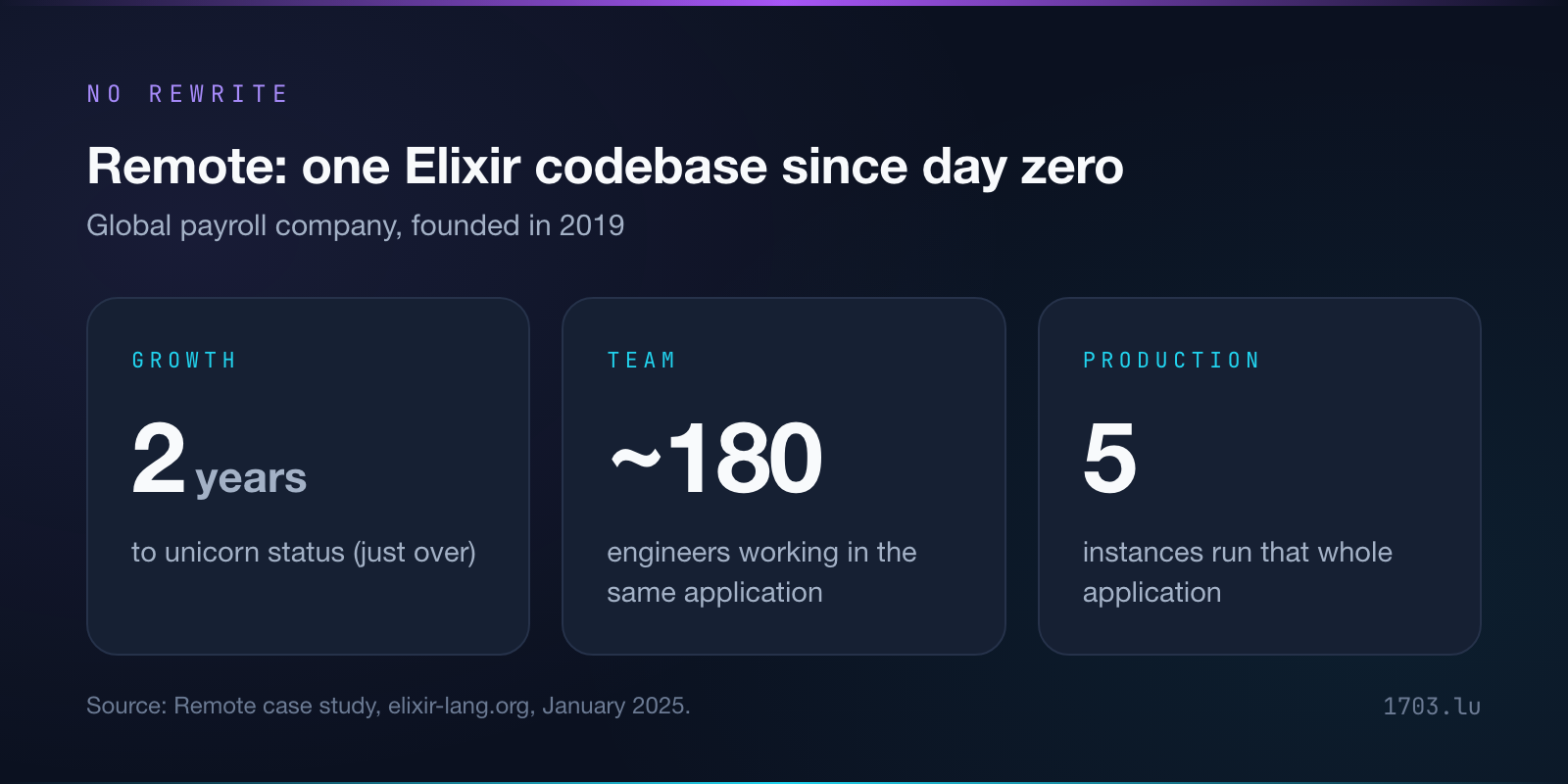
Remote, the global payroll company, is my favourite example. Elixir since day zero, a unicorn in just over two years, and they never left the codebase they started with. Almost 180 engineers work in that one application today, and it runs on five instances.
The year you don't spend on a rewrite goes into the product.
But can you hire for it?
Every founder asks this, and it's a fair question. There are fewer Elixir developers than JavaScript developers. I won't pretend otherwise.
Two things help. You need fewer of them (reason 1). And you don't have to find them ready made. Remote grew to nearly 300 engineers by hiring good senior people whether they knew Elixir or not, and then putting them through two to four weeks of internal training.
Already built on something else?
Then it's a question of whether a migration pays for itself. Sometimes it doesn't.
It's worth a look when a new feature means touching three repos, when your frontend and backend people can't cover for each other, or when the cloud bill grows faster than revenue.
It's also less scary than it sounds. Our last full migration of a production SaaS took three weeks. And you don't have to move everything at once. Pinterest started with a single system.
When would I not do it? If the product is mostly ML research or heavy data science, keep that part in Python and put Elixir around it. If you have a big team that ships fine and a stack that doesn't hurt, don't touch it.
Short version
| What you worry about | What changes | The number |
| Payroll | One engineer owns a feature end to end | Amplified: 12 developers to 2 |
| Cloud bill | The BEAM replaces most of your services | Pinterest: over $2M saved per year |
| Speed | AI assistants get Elixir right most often | Top of 20 languages in Tencent's study |
| Risk | The MVP codebase is the one you scale | Remote: a unicorn on its day one codebase |
Want the numbers for your product?
We start every engagement with a paid technical assessment. We look at what you have and what starting or migrating would really involve, and then tell you if the numbers make sense for your business.